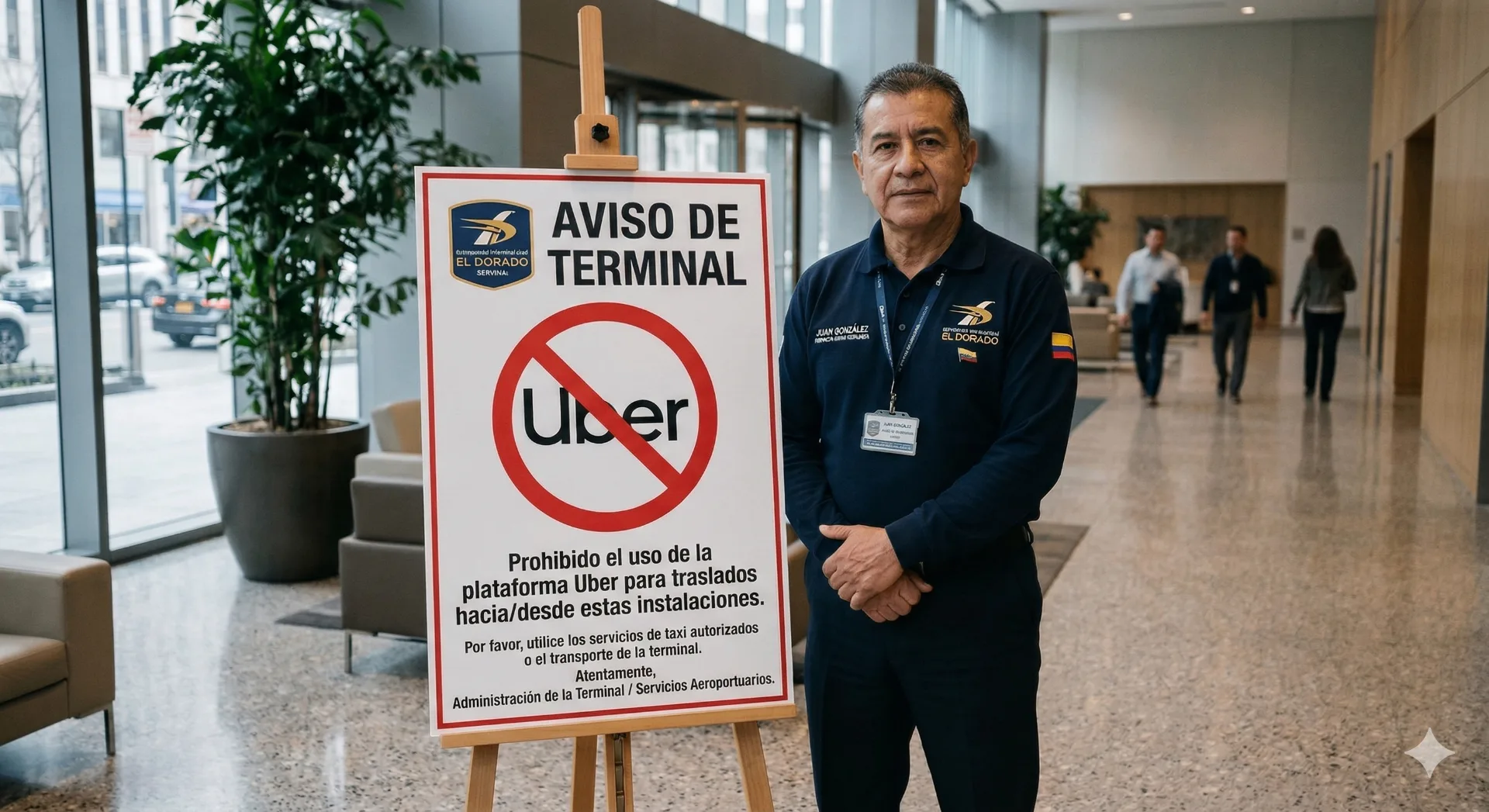
Should your company use Uber or an executive car service in Colombia? It is a question every corporate travel manager faces. The answer involves more than pricing — it touches on legal compliance, insurance coverage, employee safety, corporate liability, and Colombian transport regulations that differ significantly from those in the US and Europe. This guide provides a factual, side-by-side comparison so you can make an informed decision.
The Legal Landscape: Ride-Sharing in Colombia
Uber and ride-sharing apps operate in a regulatory gray area in Colombia. Unlike the US and Europe, Colombia has not fully legalized ride-sharing platforms for passenger transportation.
Key facts: - In January 2020, Uber temporarily left Colombia after a court ruling. It returned weeks later by restructuring as a "technology rental" platform. - DiDi, InDriver, and other apps operate under similar ambiguous frameworks. - Drivers on these platforms use personal vehicles without Ministry of Transport authorization. - There is no FUEC document (Formato Único de Extracto del Contrato) — the legally mandated trip contract required for all commercial passenger transport in Colombia. - Passengers in unauthorized vehicles have limited legal and insurance protection in case of accidents.
For corporate travel managers: If an employee is injured in an unauthorized vehicle, the company may face liability issues. Many multinationals (including Google, JP Morgan, and Bayer) require authorized ground transportation for employees in Colombia.
White Plates vs. Yellow Plates: What It Means
Colombia's vehicle plate system is key to understanding legal transportation:
White plates — Vehicles authorized by the Ministry of Transport for commercial passenger transportation (special transportation, Decree 1079 of 2015). These are legally permitted to carry paying passengers with full regulatory compliance.
Yellow plates — Authorized taxis. Metered service regulated by municipal authorities.
Private plates (also white) — Personal vehicles. NOT authorized for commercial passenger transport. Ride-sharing drivers typically use private-plate vehicles.
Why it matters: - Only white-plate authorized vehicles and yellow-plate taxis can legally transport passengers for hire. - White-plate vehicles must carry a FUEC for every trip — a government-mandated document that registers the origin, destination, passengers, vehicle, and driver. - Vehicles without proper authorization operate outside insurance and regulatory protections. - In case of an accident, passengers in unauthorized vehicles may not be covered by the driver's personal auto insurance.
FUEC: The Document Your Corporate Travel Policy Should Require
The FUEC (Formato Único de Extracto del Contrato) is a mandatory document for every commercial passenger transport trip in Colombia. It is issued by the Ministry of Transport through authorized transport companies.
What the FUEC contains: - Transport company name and authorization number - Vehicle plate, make, model, and year - Driver name, ID, and license details - Trip origin, destination, dates, and route - Passenger or contracting company information - Contract number
Why it matters for corporations: - It is legally required — operating without one is a violation of Colombian transport law. - It proves the vehicle is authorized and insured for passenger transport. - In case of an accident or incident, the FUEC is the document that activates insurance coverage and legal protections. - Colombian authorities (transit police) can stop any vehicle and request the FUEC. Vehicles without it can be impounded.
Neither Uber, DiDi, nor InDriver provide a FUEC. Only authorized transport companies like Transportes Ejecutivos issue this document for every trip.
Insurance: The Hidden Risk of Ride-Sharing for Business Travelers
Authorized executive car services: - Contractual liability insurance covering all passengers - Extra-contractual liability insurance - Mandatory SOAT (traffic accident insurance) - Vehicle inspection (Revisión Técnico Mecánica) current - Bureau Veritas biosafety certification (in the case of Transportes Ejecutivos)
Ride-sharing apps: - Driver's personal auto insurance (which typically excludes commercial use) - SOAT (mandatory for all vehicles) - No contractual liability insurance for passengers - No extra-contractual liability insurance - No third-party corporate insurance
The corporate risk: If an employee is injured in a ride-sharing vehicle and the driver's personal insurance denies the claim (because the vehicle was being used commercially), the corporation may bear the financial and legal burden. This is why companies like FedEx, DHL, and pharmaceutical firms require pre-authorized transportation in Colombia.
Feature-by-Feature Comparison
Legal authorization: - Executive car service: Ministry of Transport authorized (white plates) ✓ - Uber/DiDi: No Ministry authorization ✗
FUEC document: - Executive car service: Issued for every trip ✓ - Uber/DiDi: Not available ✗
Corporate billing & invoicing: - Executive car service: Monthly invoicing, cost center reporting, multiple payment methods ✓ - Uber/DiDi: Per-ride receipts only, limited corporate features ✗
Meet & greet at airports: - Executive car service: Greeter with name sign at arrivals gate ✓ - Uber/DiDi: Pick-up at departures level, no greeter ✗
Flight monitoring: - Executive car service: Real-time adjustment for delays at no extra cost ✓ - Uber/DiDi: Must re-request ride after landing ✗
Vehicle selection: - Executive car service: Sedan, SUV, van, bus, Mercedes-Benz, armored ✓ - Uber/DiDi: Limited categories, no armored option ✗
Driver vetting: - Executive car service: Background checks, psychometric tests, executive protocol training ✓ - Uber/DiDi: App-based background check ✗
Bilingual drivers: - Executive car service: Available on request ✓ - Uber/DiDi: Not guaranteed ✗
Pricing: - Executive car service: Fixed rate, no surge pricing - Uber/DiDi: Variable, surge pricing during peak hours
The majority of Fortune 500 companies operating in Colombia use authorized executive car services for employee ground transportation. Here is why:
Compliance departments require it. Corporate travel policies in companies like Google, AWS, JP Morgan, Bayer, Novartis, and Merck mandate authorized transportation in Colombia.
Insurance and liability. Risk management teams understand that unauthorized transportation creates uninsured exposure.
Duty of care. Employers have a legal and ethical obligation to protect employees during business travel. Using authorized, insured, GPS-tracked vehicles is part of that duty.
Audit trail. Executive car services provide complete documentation: FUEC, invoices, trip reports, cost center allocation, and driver information for every service.
Transportes Ejecutivos serves 230+ corporations including Google, AWS, JP Morgan, FedEx, DHL, Bayer, Novartis, Merck, P&G, Red Bull, LATAM Airlines, the US Embassy, British Embassy, and Embassy of Japan.
FAQ
Switch to authorized executive transportation in Colombia
Legal compliance, full insurance, corporate billing, FUEC for every trip. Trusted by Google, JP Morgan, FedEx, and 230+ corporations.